Startup Ideas for 2026: Real Opportunities in a Changing World
1. Introduction
If you look at the business world in 2026, one thing becomes very clear. Big ideas are everywhere, but only a few people are actually building them. Many reports say that the global wellness tourism market is moving close to one trillion dollars, and AI tools are now used in thousands of companies.
But something important is changing.
For many years, people talked a lot about technology, innovation, and disruption. Now investors and customers are asking a simple question. Can you actually build and run the idea?
Because of this shift, 2026 is often called the year of execution over hype.
In this article, I will walk you through some startup ideas that are becoming important. Some of them are based on advanced technology like artificial intelligence. Others are simple service businesses that require small investment.
My goal here is simple. I want to help you understand where real opportunities are appearing and how you can think about starting something of your own.
2. The Tech Frontier: Beyond Chatbots
Over the last few years, most people saw artificial intelligence as chatbots. These tools answered questions, wrote content, or helped with simple tasks.
But in 2026, AI is changing in a big way.
Now the focus is not only on AI that talks. The focus is on AI that takes action.
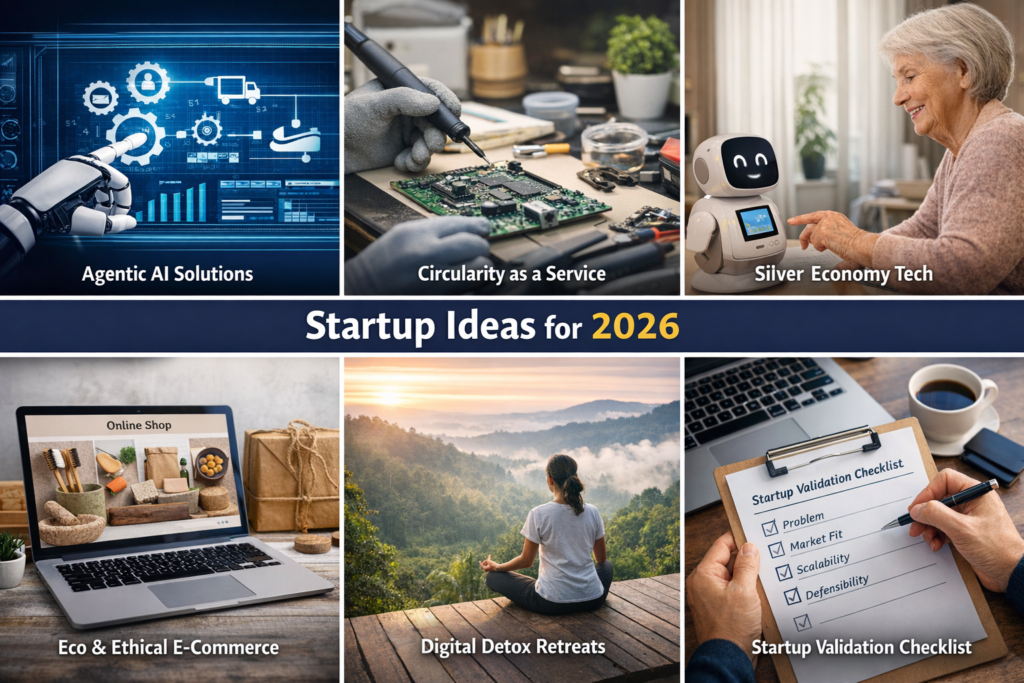
These systems are often called agentic AI. Instead of just giving suggestions, the AI can complete tasks on its own. For example, imagine a system that manages a company’s supply chain. It can track inventory, contact suppliers, place orders, and schedule deliveries. All these steps can be handled automatically.
This means businesses can save time and reduce manual work.
Another interesting trend is vertical AI agents. These are AI tools that are built for one specific industry. Instead of trying to help everyone, the software is designed for a particular profession.
For example, a legal AI system can review contracts and prepare summaries for lawyers. HR departments can use AI to screen job applications and schedule interviews. In the construction industry, AI tools can track project progress and manage resources.
At the same time, new risks are also appearing.
Deepfakes and synthetic media are becoming more realistic every year. Sometimes it becomes difficult to know whether a video or audio clip is real.
Because of this problem, companies are now investing in AI trust and security systems. These systems help detect fake content, verify digital identity, and protect important information.
Startups that focus on building trust in the AI world will have a strong future.
3. The Sustainability Shift: Circularity as a Service
Sustainability is no longer only a social topic. Today it is also a strong business opportunity.
In 2026, many startups are being built around the idea of using resources more carefully. Energy, materials, and water are all being managed in smarter ways.
One growing area is eco friendly infrastructure. In many places, small communities are building local energy systems called microgrids. These systems produce electricity using solar panels or other renewable sources. The power is stored in local batteries and used within the community.
This model reduces dependence on large power grids.
Another big opportunity comes from the circular economy. Instead of throwing away products, companies are finding ways to repair and reuse them.
For example, electronics can be refurbished and sold again. Office furniture can be repaired and upgraded. Appliances can be restored instead of replaced.
Businesses that offer refurbish as a service are becoming popular.
There is also growing demand for water efficient technology. Data centres are expanding very quickly because of cloud computing and artificial intelligence. These centres need powerful cooling systems.
If startups can build cooling solutions that use less water and less energy, they will play an important role in future tech infrastructure.
4. Health and Longevity: Biohacking 2.0
Health is becoming one of the biggest industries in the world. People are no longer thinking only about treating illness. They are also trying to stay healthy for a longer time.
Because of this shift, new business ideas are appearing in the health and wellness space.
One strong trend is precision nutrition. Many people now use wearable devices and health sensors. Some of these devices measure blood sugar levels throughout the day.
This data can be analysed by AI systems. After that, personalised meal plans can be suggested. The goal is simple. People want to understand how their body reacts to food.
Another growing opportunity is connected to the silver economy.
Across the world, the number of older adults is increasing. Many seniors prefer to live in their own homes instead of moving to care facilities.
Technology can support this lifestyle. Smart home systems can monitor safety. Health sensors can track important signs. Even small robots are being developed to help with daily tasks.
There is also a new trend that might surprise you.
Many people are now looking for digital detox experiences. Our lives are filled with screens, notifications, and constant information. Because of this, people want short breaks from technology.
Offline retreats, nature stays, and mental wellness programs are becoming popular forms of tourism.
5. Low Investment and Online Business Ideas
Not every startup needs large funding or advanced technology. In fact, many profitable businesses start with small investments.
The internet has made it easier than ever to reach customers.
One good example is niche e commerce. Instead of competing with huge marketplaces, entrepreneurs are building small online stores that serve very specific audiences.
Some stores sell handmade products. Others focus on eco friendly or zero waste lifestyles. Customers who care about these values are happy to support such brands.
Another promising area is specialised online education.
For many years, the internet was filled with generic courses. But now people want training that directly helps their career.
For example, a course called “AI for Architects” can attract professionals in that field. Similarly, training programs for automation, design tools, or industry software are gaining demand.
There is also growth in fractional services.
Many small businesses need expert help in marketing, finance, or technology. But hiring a full time executive is expensive.
So companies are now hiring fractional leaders. A fractional marketing officer or technology officer works part time with several companies.
This model is flexible for both sides.
6. Future Proofing: How to Validate Your Startup Idea
Starting a business is exciting. But before you invest time and money, it is important to test your idea.
A simple method is called the pain point test.
You can ask yourself a basic question. Is your product a vitamin or a painkiller?
A vitamin is useful, but people can live without it. A painkiller solves a strong problem. When a product removes a real pain, customers are more willing to pay for it.
Another important factor is scalability.
A good startup should grow without needing a huge team. Automation tools, digital platforms, and software systems can help businesses serve many customers at the same time.
This means growth can happen without increasing costs too quickly.
You should also think about defensibility.
If your idea can be copied easily, competitors will appear very quickly. But if your business builds strong data, a loyal community, or unique systems, it becomes much harder to replace.
That advantage will protect your startup in the long run.
7. Conclusion and Next Steps
If we look carefully at 2026, one message becomes clear. The best startup ideas are not only about technology or trends.
The strongest businesses solve real problems using modern tools.
Opportunities exist in many areas. Artificial intelligence, sustainability, health, and simple service models are all creating new possibilities.
The good news is that starting a business has become easier. Tools, platforms, and knowledge are available to almost anyone.
But the expectations are also higher. Customers now expect real value and reliable solutions.
If you are thinking about launching a startup, start by validating your idea. A simple checklist can help you test the problem, the market, and the business model.
And if you enjoyed this article, I would love to hear from you.
You can share your favourite startup niche or idea in the comments and join the conversation.