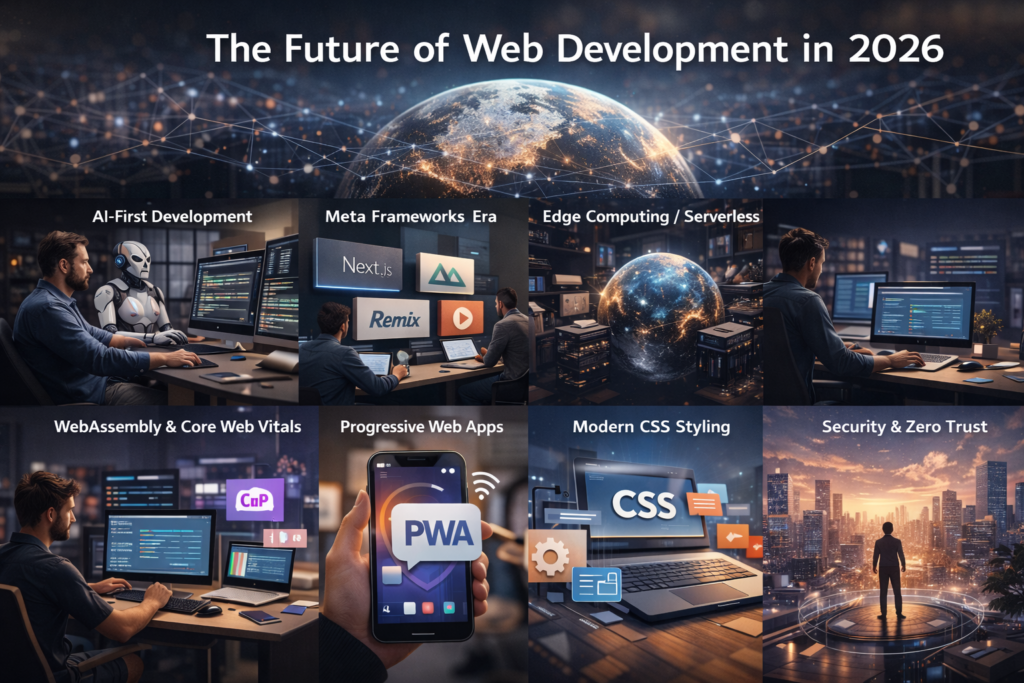
The Future of Web Development in 2026
1. Introduction
If you look at the internet today, it is very different from how it started. In the early days, websites were simple. They had a few pages with text and images. People mainly used them to read information.
Today, websites have become powerful digital systems. Online stores, banking platforms, learning websites, and social apps all run on the web. These platforms are built with advanced technology that works in real time.
As we move into 2026, web development is changing again. Developers are spending less time writing basic code. More time is being spent on planning systems and designing smart solutions.
Another big change is the use of Artificial Intelligence. AI tools now help developers build faster and solve problems quickly. When developers and AI work together, better products can be created.
To stay ahead in this field, it is not enough to learn only new tools. It is more important to understand how systems are designed and how AI can support the development process.
2. AI First Development and Agent Workflows
Artificial Intelligence is changing the way software is built. Earlier, AI tools were used only to suggest small pieces of code. This helped developers save some time.
Now the technology has become much smarter. AI tools can create full features, generate user interface components, and even help design application logic.
Because of this change, the role of a developer is also changing. Earlier, most time was spent writing code line by line. Today, developers are acting more like architects. Systems are planned first, and AI is used to help build them.
Prompt writing has also become an important skill. Developers give clear instructions to AI systems so that the correct code can be generated.
AI is also helping with debugging. Problems in the system can be found faster. In some cases, performance issues are detected automatically.
Another interesting area is predictive user interfaces. These systems learn how users behave. Based on that information, the interface can adjust itself to improve the experience.
Because of these changes, development is becoming faster and smarter. AI driven web development, automated code generation, and generative user interfaces are becoming common in modern projects.
3. The Rise of Meta Frameworks
In the past, setting up a web project was often difficult. Developers had to configure bundlers, routing systems, and optimisation tools manually. A lot of time was spent on setup before real development even started.
Today this problem has mostly been solved. Modern frameworks provide ready made systems that manage these tasks automatically. Frameworks such as Next.js, Nuxt, and Remix are widely used.
These tools handle routing, server side rendering, and performance optimisation by default. As a result, developers can focus on building the actual product.
Another trend that is growing quickly is the modular approach used by tools like TanStack Query. Instead of using a single large framework for everything, developers combine smaller specialised tools. This makes systems more flexible and easier to maintain.
React is also improving performance with a new feature called React Forget. This compiler automatically optimises components and manages memoisation. Because of this, developers do not need to manually handle many performance settings.
All these changes are making development cleaner and faster. The meta framework era is clearly shaping how modern applications are built.
4. Edge Computing and Serverless Systems
Speed is very important for modern web applications. If a website loads slowly, users often leave quickly.
To solve this problem, many companies are moving towards edge computing. In this model, the application runs closer to the user instead of on a single central server.
Platforms like Vercel and Cloudflare provide global networks where applications can run at many locations around the world. Tools such as Cloudflare Workers make this possible.
Because the system runs near the user, data travels a shorter distance. As a result, websites respond much faster.
Another trend is serverless architecture. Developers write small functions that run only when they are needed. Infrastructure management is handled automatically by the platform.
In many modern systems, the line between frontend and backend is becoming less clear. Some logic that once ran only on servers is now handled closer to the browser.
For large applications with global users, this distributed model offers better scalability and performance.
5. Performance with WebAssembly and Core Web Vitals
Modern websites are expected to perform complex tasks directly in the browser. To support this, developers are using technologies like WebAssembly.
WebAssembly allows programs written in languages such as C or Rust to run inside the browser with very high speed. This makes it possible to run advanced tools like video editors, design software, and 3D games on the web.
At the same time, performance is also important for search rankings. Metrics introduced by Google measure how fast and responsive a website feels.
These measurements are known as Core Web Vitals. Metrics like Largest Contentful Paint and Interaction to Next Paint show how quickly a page loads and how fast it reacts to user actions.
Another useful idea is the islands architecture used by frameworks such as Astro. In this approach, only the interactive parts of a page use JavaScript. The rest of the page stays simple and lightweight.
Because of this design, pages load faster and the user experience improves.
6. Progressive Web Apps and the App Like Web
Many businesses want their websites to behave like mobile apps. Progressive Web Apps make this possible.
With technologies such as Service Workers, websites can continue working even when the internet connection is weak or temporarily unavailable. This is known as an offline first experience.
Users can also install these websites on their phones or computers. Once installed, the website behaves like a normal mobile application.
Another useful feature is web push notifications. Businesses can send updates or alerts directly to users even when the website is not open.
Because of these benefits, many companies are choosing PWAs instead of building separate native apps. Development costs are reduced and updates can be delivered instantly.
7. Modern CSS and Simpler Styling
Styling websites used to require many JavaScript libraries. Today, modern CSS has become much more powerful.
Features like container queries allow elements to adjust their layout based on the space around them. This gives designers more flexibility when creating responsive designs.
CSS variables also help developers manage colours, spacing, and themes easily.
Utility based frameworks such as Tailwind CSS are also widely used. These tools help developers write styling rules quickly while keeping the design consistent.
Because native CSS features are improving, many developers are moving away from heavy styling libraries. Websites become lighter and performance improves.
8. Security and Ethical Web Development
Security has become a major concern for modern applications. Users expect their data to be protected and handled responsibly.
One important change is the move away from third party cookies. Companies are now focusing more on first party data that users willingly share.
Another important concept is Zero Trust architecture. In this model, no request is automatically trusted. Every user and system must be verified before access is granted.
Security is also being integrated directly into the development process. This approach is known as DevSecOps. Automated tools scan code, detect vulnerabilities, and check dependencies during development.
Because security is built into the workflow, problems can be detected earlier and fixed quickly.
9. Conclusion
The web in 2026 is becoming faster, smarter, and more modular. Artificial Intelligence, edge computing, and modern frameworks are changing how applications are built.
Developers today are not just writing code. They are designing systems and creating digital experiences.
If you are learning web development, focus on understanding how technologies work together. Architectural thinking will be more valuable than simply memorising syntax.
The web is no longer just a place where we read information. It is becoming a powerful platform where the future of digital experiences is being created every day.